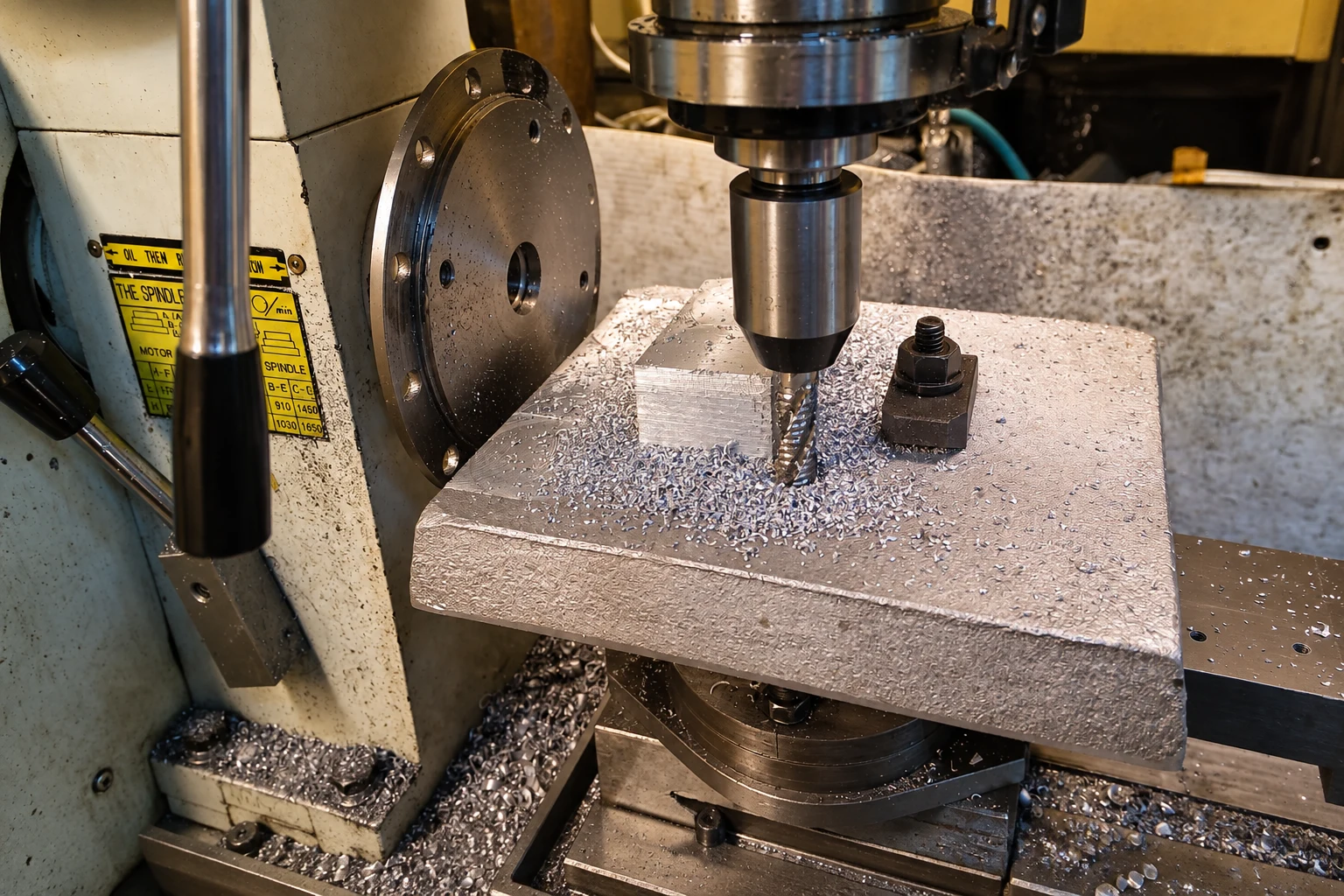

Quick answer: yes, when the tool and cut leave enough room for chips
A 4-flute end mill can machine aluminum, but flute count alone does not make it suitable. The tool needs geometry and an edge condition intended for non-ferrous material, and the operation must provide enough chip evacuation. Four flutes are more plausible in light radial engagement, finishing and stable toolpaths than in a deep full-width slot where every flute must carry a large chip out of a confined space.
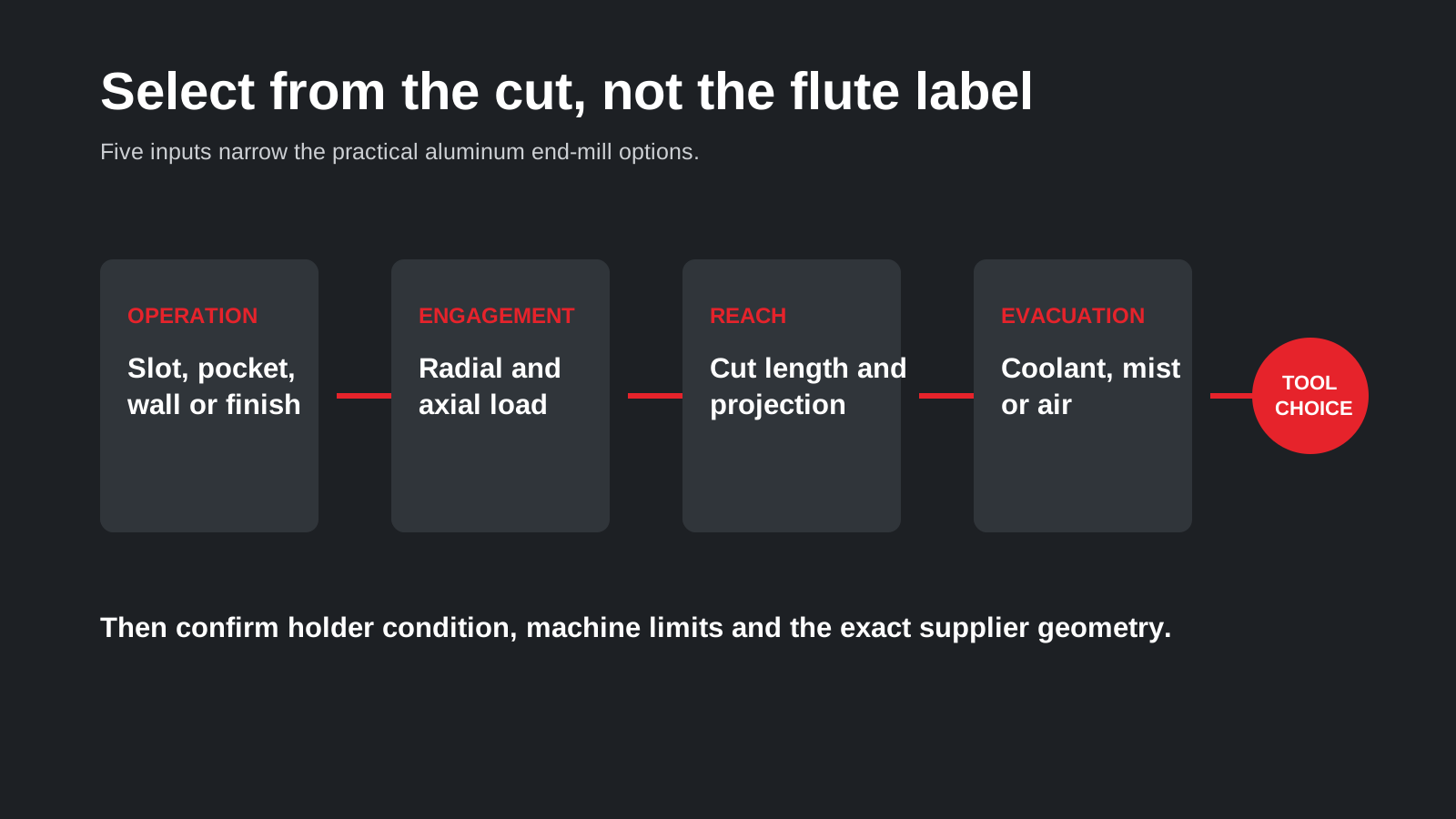
If you only know the diameter and flute count, you do not yet have enough information to choose. Confirm alloy, operation, axial and radial engagement, reach, coolant or air delivery, holder and machine speed range.
Why flute count matters in aluminum
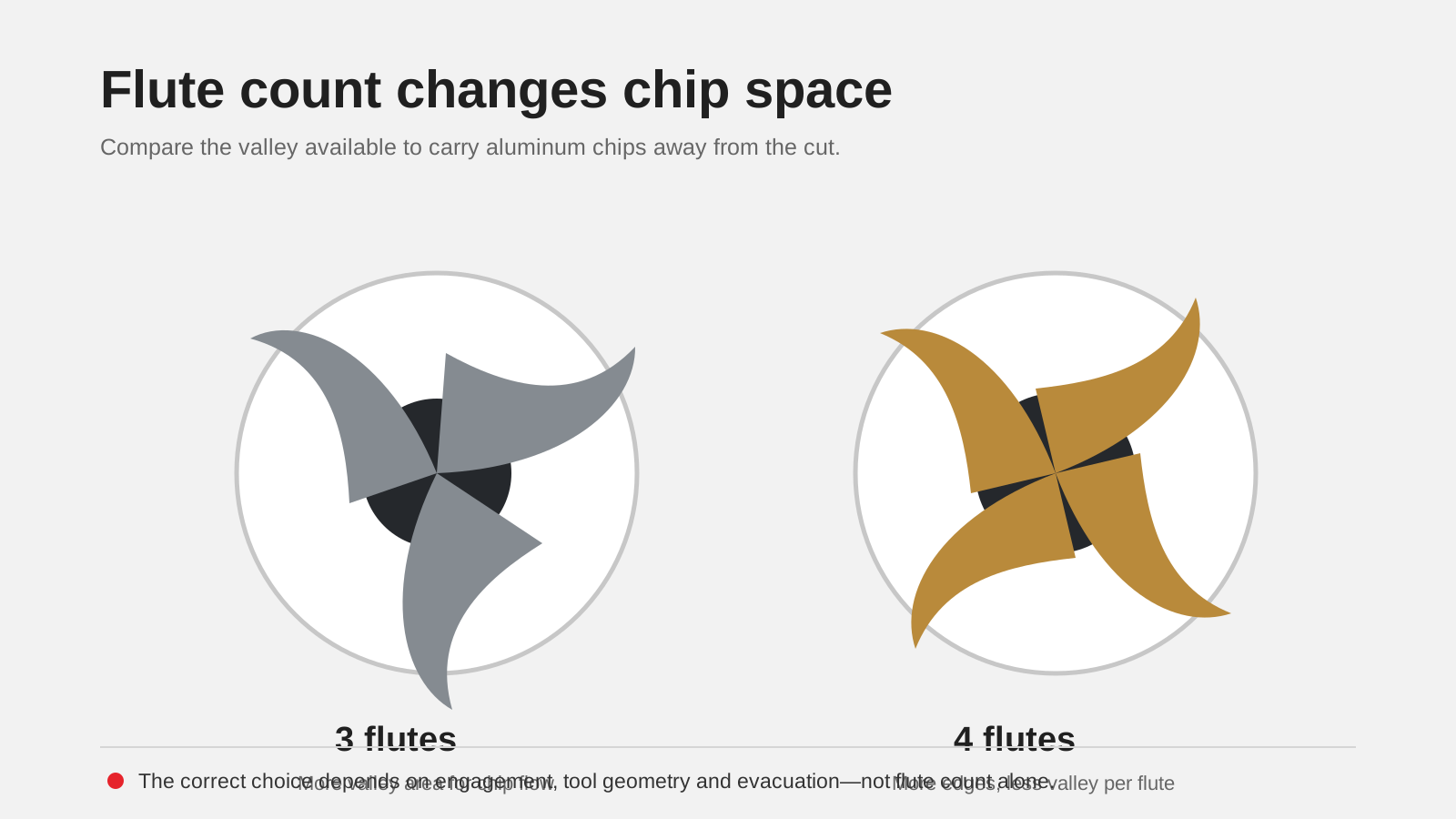
Every added flute creates another cutting edge, but it also reduces the space between adjacent edges. That space is the chip valley. Aluminum can form relatively large, continuous chips, so a tool that creates chips faster than it clears them may recut material, build heat and load the flutes.
More flutes increase edge engagements
At the same spindle speed and feed per tooth, a 4-flute tool has more cutting engagements per revolution than a 3-flute tool. This can support a higher programmed feed when the machine, holder, tool and cut are stable. It does not mean four flutes automatically remove more aluminum: evacuation and available spindle speed may become the limiting factors first.
Fewer flutes create more chip space
Two- and three-flute aluminum tools traditionally provide larger valleys for chips. Harvey Performance notes that increasing flute count reduces chip-valley space and can make evacuation more difficult at the high speeds commonly used for aluminum. Its guide also explains that three flutes can work successfully in many finishing operations and, with the right conditions, in roughing.
When a 4-flute end mill can work well
Light radial engagement and adaptive toolpaths
When only a limited portion of the tool diameter is engaged, chips have a clearer exit path than in full slotting. A suitable 4-flute aluminum tool can use its additional edges while avoiding the chip packing associated with a closed slot. Toolpath, corner engagement and programmed chip thickness still need to be controlled.
Finishing walls and floors
Finishing cuts generally remove less material than roughing cuts. With a rigid setup and an aluminum-specific cutting edge, four flutes can provide useful support and engagement frequency. Surface finish is not guaranteed by flute count; runout, edge condition, tool deflection and built-up edge can dominate the result.
Small diameters with geometry designed for the job
At small diameters, tool strength and usable flute form may influence the choice differently than on a large roughing tool. Some manufacturers offer higher-flute-count tools for non-ferrous work. Treat that as a product-specific design decision, not permission to use any general-purpose 4-flute cutter.
When a 3-flute aluminum end mill is the safer starting point
Full-width slotting
A slot surrounds much of the cutter, leaving less room for chips to escape. A purpose-built 3-flute aluminum end mill usually offers more valley area than a comparable 4-flute tool. Air blast, coolant direction, step-down and toolpath still determine whether chips leave the slot.
High material-removal operations
If the objective is to remove a large volume of aluminum and each tooth produces a substantial chip, evacuation deserves priority. A lower flute count may provide more space, while a polished or sharp edge and suitable surface treatment help control adhesion. The exact choice must follow the actual cutter design.
Machines with limited chip evacuation
An enclosure full of recirculating chips, weak coolant aim or no air delivery can turn a workable cut into flute loading. Changing flute count may help, but it does not replace clearing chips from the cutting zone.
Seven selection checks beyond flute count
- Aluminum alloy: wrought, cast and high-silicon alloys do not behave identically.
- Operation: slotting, pocketing, side milling and finishing expose different amounts of the cutter.
- Tool diameter: it changes chip volume, stiffness and available flute geometry.
- Cutting length and reach: use only what the feature requires; unnecessary projection reduces rigidity.
- Edge and flute finish: inspect whether the tool is designed to resist aluminum adhesion.
- Coolant, mist or air: state what actually reaches the cutting zone.
- Holder and runout: uneven flute loading can make one edge fail before the others work correctly.
Compare the exact 4-flute flat end mill and three-flute options rather than treating flute count as a material label.
Signs that the current 4-flute setup is not evacuating chips
Material packed into the flutes
Stop and inspect when aluminum adheres between cutting edges. Continuing can raise forces and damage the tool or workpiece. Check whether chips are being recut, whether lubrication reaches the edge and whether the selected tool is intended for aluminum.
A sudden change in sound or finish
A deteriorating sound, smeared surface, burr increase or unexpected spindle load can indicate chip packing, runout or instability. These symptoms are not a diagnosis by themselves. Record where they occur in the toolpath and inspect the edges before changing several parameters at once.
One flute wears differently
Uneven wear can point to runout, holder contamination, a damaged collet or an assembly problem. Measure the tool near the cutting region using an appropriate setup rather than relying only on runout at the shank.
What to send for a practical recommendation
Send the aluminum alloy, operation, slot or radial engagement, depth, diameter, required flute length, overall reach, holder type, machine maximum speed, coolant method and quantity. If a current tool is failing, include photos of every cutting edge and the machined surface.
Vextrex can compare 3-flute aluminum, 4-flute flat and long-reach 4-flute options. Final geometry, coating, stock, price and lead time are confirmed for the selected specification.
Record the approved tool as a complete specification
For repeat orders, keep diameter, flute count, cutting length, reach, shank, corner form, edge preparation, coating or surface treatment and supplier grade together. “10 mm, four flute” is not enough to reproduce a successful process. Photograph the box label and retain the approved cutting-data sheet with the job record.
Run a controlled first-piece trial
Verify holder assembly, tool offset and coolant direction before cutting. Start from data issued for the exact tool, monitor chip shape and evacuation, and stop if chips pack into the flutes. Record the stable spindle speed, programmed feed, axial depth and radial engagement instead of relying on memory.
Frequently asked questions
Can a standard 4-flute end mill cut aluminum?
It can remove material, but that does not make it the best or safest production choice. Confirm that the geometry, edge, flute finish and evacuation plan suit aluminum.
Is a 3-flute end mill always better for aluminum?
No. Three flutes often offer a useful balance of chip space and productivity, but operation, diameter, rigidity and the exact cutter design remain decisive.
Why does aluminum stick to an end mill?
Adhesion can involve heat, edge condition, chip recutting, lubrication, alloy and cutting data. Inspect the complete process rather than blaming flute count alone.
Can speed and feed be selected from diameter alone?
No. Use verified data for the exact tool and adjust it for alloy, engagement, reach, holder and machine limits.
Manufacturer references
- Harvey Performance, Attacking Aluminum: A Machining Guide.
- ISO 1641-1, end mills and slot drills with cylindrical shanks.
Manufacturer recommendations apply to the specified product family. Do not transfer cutting data between different geometries without validation.
Turn the selected tool into a repeatable process
For repeat orders, retain diameter, flute count, cutting length, reach, shank, corner form, edge preparation, coating or surface treatment and supplier grade together. “10 mm, four flute” is not enough to reproduce a successful process. Photograph the box label and keep the approved cutting-data sheet with the job record.
| Operation | Option to investigate | Primary check |
|---|---|---|
| Deep full-width slot | Purpose-built 2- or 3-flute aluminum tool | Chip evacuation |
| Light radial engagement | 3- or aluminum-specific 4-flute tool | Chip thickness and runout |
| Finishing wall or floor | 3- or 4-flute aluminum geometry | Edge and surface target |
Verify holder assembly, tool offset and coolant direction before the first trial. Start from data issued for the exact tool, monitor chip flow and stop if chips pack into the flutes. Record the stable result instead of relying on memory.
Need help confirming the exact tool specification?
Send the model code, clear tool photos, workpiece material and machining task. We will review compatibility and application details before confirming available options, price and lead time.