
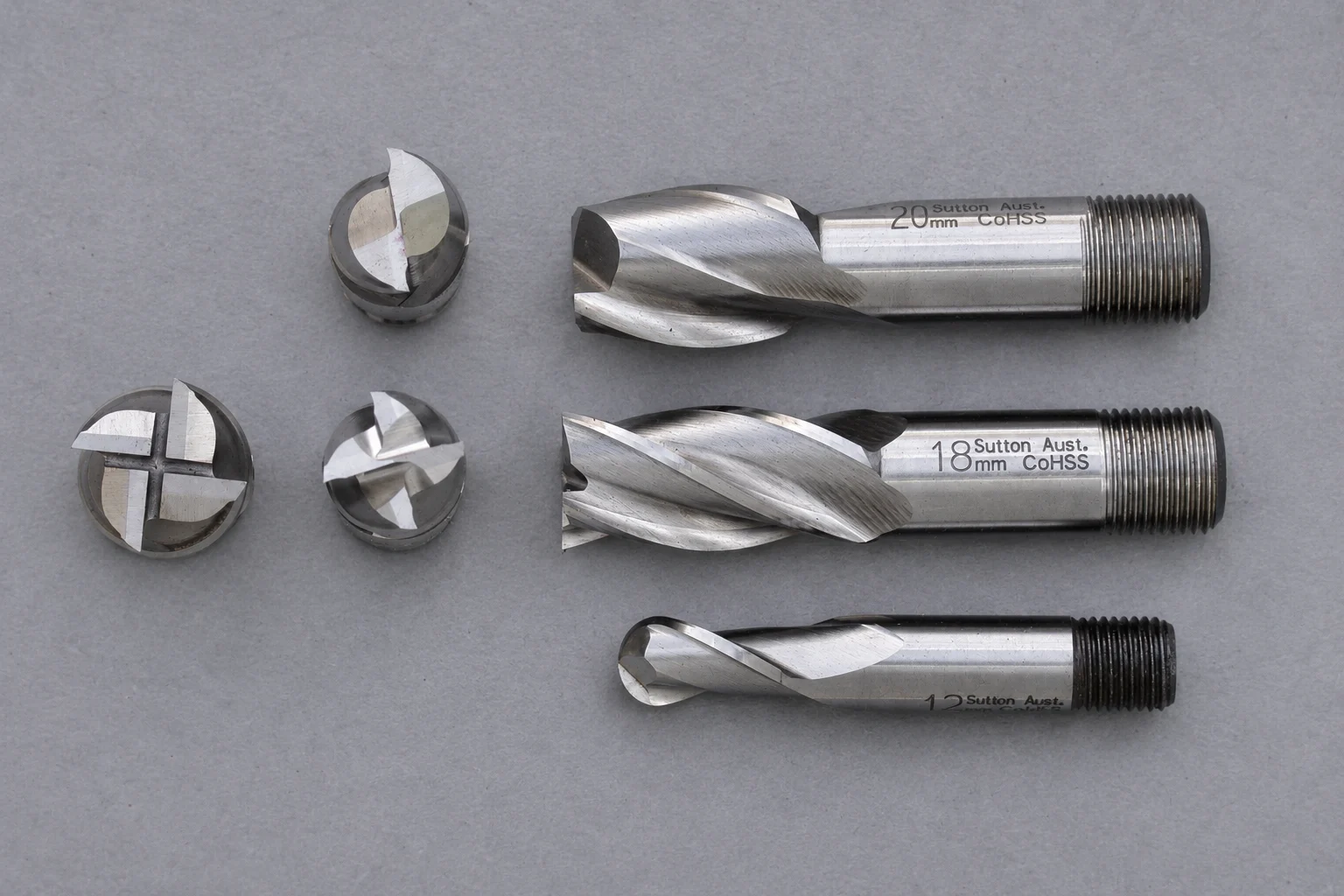

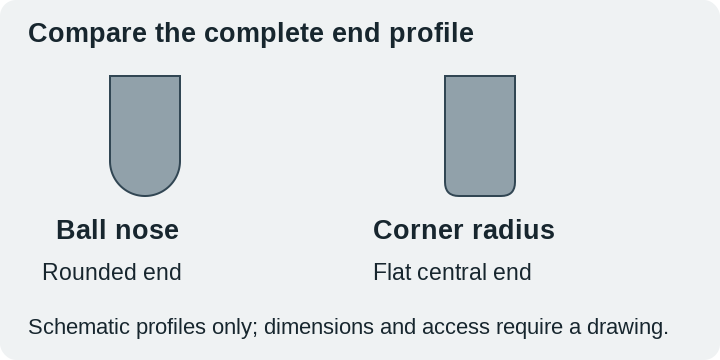
A ball nose and a corner radius end mill do not have the same end profile. The first has a rounded end; the second retains a flat central end area with radiused outside corners. Before asking for a radius tool, identify whether the part needs a floor-to-wall fillet, a curved surface or an internal corner viewed from above.
Locate the radius in the correct view
Mark the radius on a section or model view. A fillet between a horizontal floor and a vertical wall is a different feature from an internal corner in the plan view of a pocket. The tool’s corner radius alone does not define its ability to enter that pocket corner; diameter and access also matter. Send both views when the drawing could be interpreted in more than one way.
Compare the end profiles
A hemispherical ball nose with a nominal diameter of 6 mm has a nominal spherical radius of 3 mm. A 6 mm corner radius end mill can instead have, for example, a specified 0.5 mm corner radius and a flat central end. These are hypothetical geometric examples, not catalogue offers. Replacing one with the other changes the tool profile represented in the program and may leave different stock.
Include the surface and tool contact
Sandvik’s profile-milling guidance uses ball nose and radius tools for different stages of contour machining and highlights the effective diameter in contact. Near the centre of a ball nose, cutting speed is low. Do not copy a spindle-speed choice based only on the nominal diameter from an unrelated toolpath. The actual surface, tool orientation, contact and toolmaker’s guidance determine the process.
| Item | What to verify |
|---|---|
| Ball nose | Rounded end profile; verify the nominal and effective diameters |
| Corner radius end mill | Flat central end with a separately specified corner radius |
| Floor fillet | Identify its radius in a section view |
| Pocket plan-view corner | Check tool diameter and access, not only the tip radius |
Specify more than diameter and radius
Ask for the end profile, diameter, corner radius where applicable, cutting length, reach and shank together. Include the material, finish requirement and whether the operation is roughing or finishing. The programmer should verify the tool geometry and holder clearance in the approved path. A sample that merely fits the holder has not yet demonstrated that it produces the required part feature.
Qué enviar con su consulta
Send Vextrex a section or model view showing the required radius, material and tool reach. State whether you need a ball nose or a flat-end corner radius candidate if the drawing already defines it. Contact Vextrex.
Related reading: end mill flute-count selection · tool reach and milling stability.
Technical references
¿Necesita ayuda para confirmar la especificación exacta de la herramienta?
Enviar el código modelo, fotos de herramientas claras, material de pieza y tarea de mecanizado. Revisaremos la compatibilidad y los detalles de la aplicación antes de confirmar las opciones disponibles, precio y tiempo de entrega.