
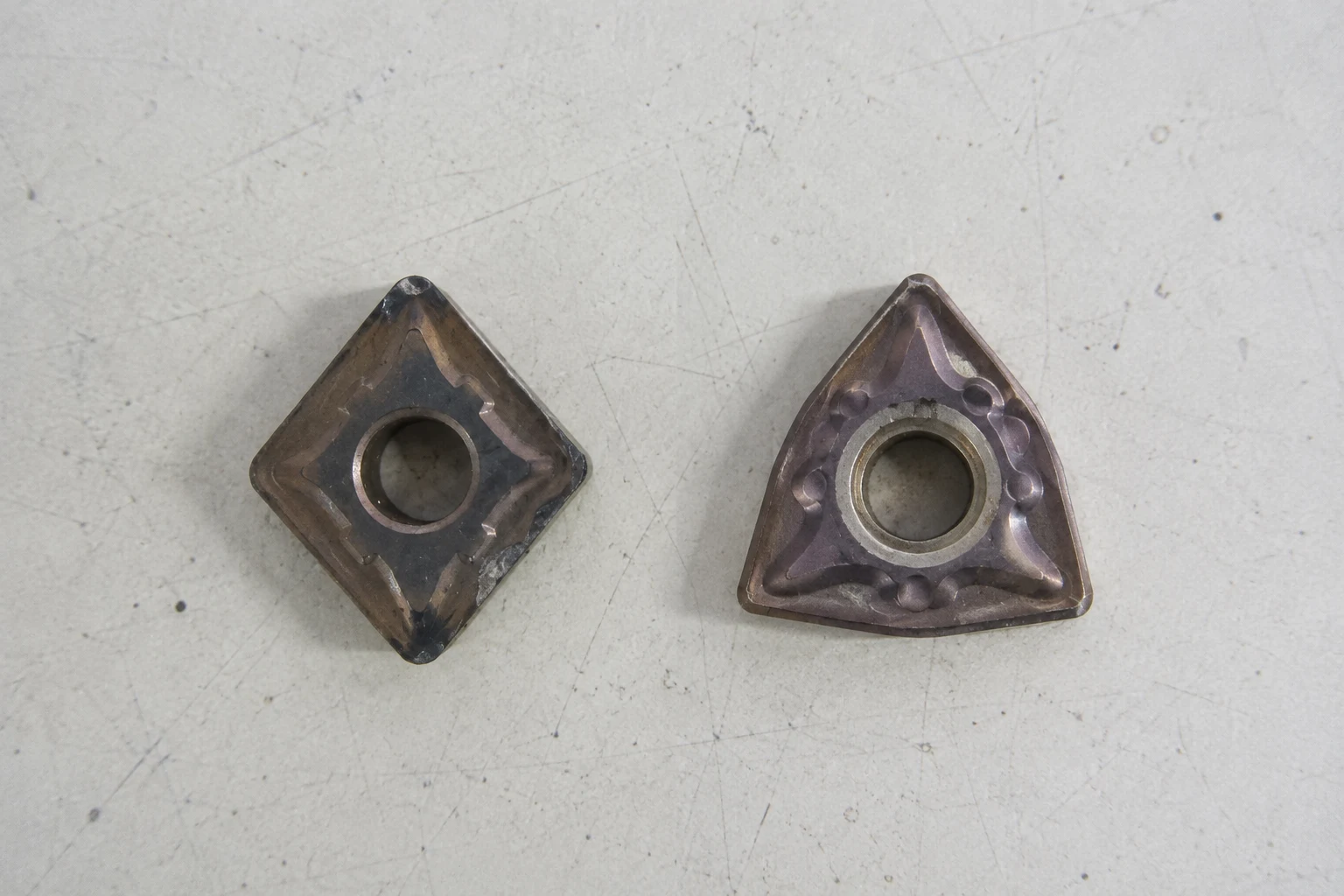

Two insert boxes can look like alternative solutions to the same turning job, yet require different holders and produce different purchasing economics. Comparing WNMG vs CNMG inserts starts with the complete tool assembly, not the price per box or a claim that one shape is always stronger.
For a workshop supervisor, the question is whether a change produces more acceptable parts without creating setup problems. For a distributor, it is whether the supplied insert actually matches the customer’s holder, component and machining conditions.
1. WNMG vs CNMG Inserts: The Practical Differences
CNMG has an 80-degree rhombic outline. WNMG uses an 80-degree trigon outline, not a conventional 60-degree triangular shape. The shared primary corner angle does not mean their seating outlines match. The manufacturer’s ISO turning insert catalog distinguishes these families.
For conventional double-sided designs, CNMG commonly provides four primary 80-degree cutting corners across both faces; WNMG commonly provides six. Some CNMG applications can use the larger-angle corners, but do not include these in your cost calculation unless the actual holder and operation support them. Confirm usable edges for the supplied geometry.
The N position indicates zero nominal clearance. This does not describe every local rake angle formed by the chipbreaker, nor determine cutting forces on its own. Grade, geometry, edge preparation and holder orientation remain separate selection inputs.
| Purchasing check | CNMG | WNMG |
|---|---|---|
| Basic outline | 80-degree rhombic | 80-degree trigon |
| Common primary corners, double-sided | Four | Six |
| Required holder | Approved CNMG pocket and fastening system | Approved WNMG pocket and fastening system |
| Application decision | Complete configuration and job | Complete configuration and job |
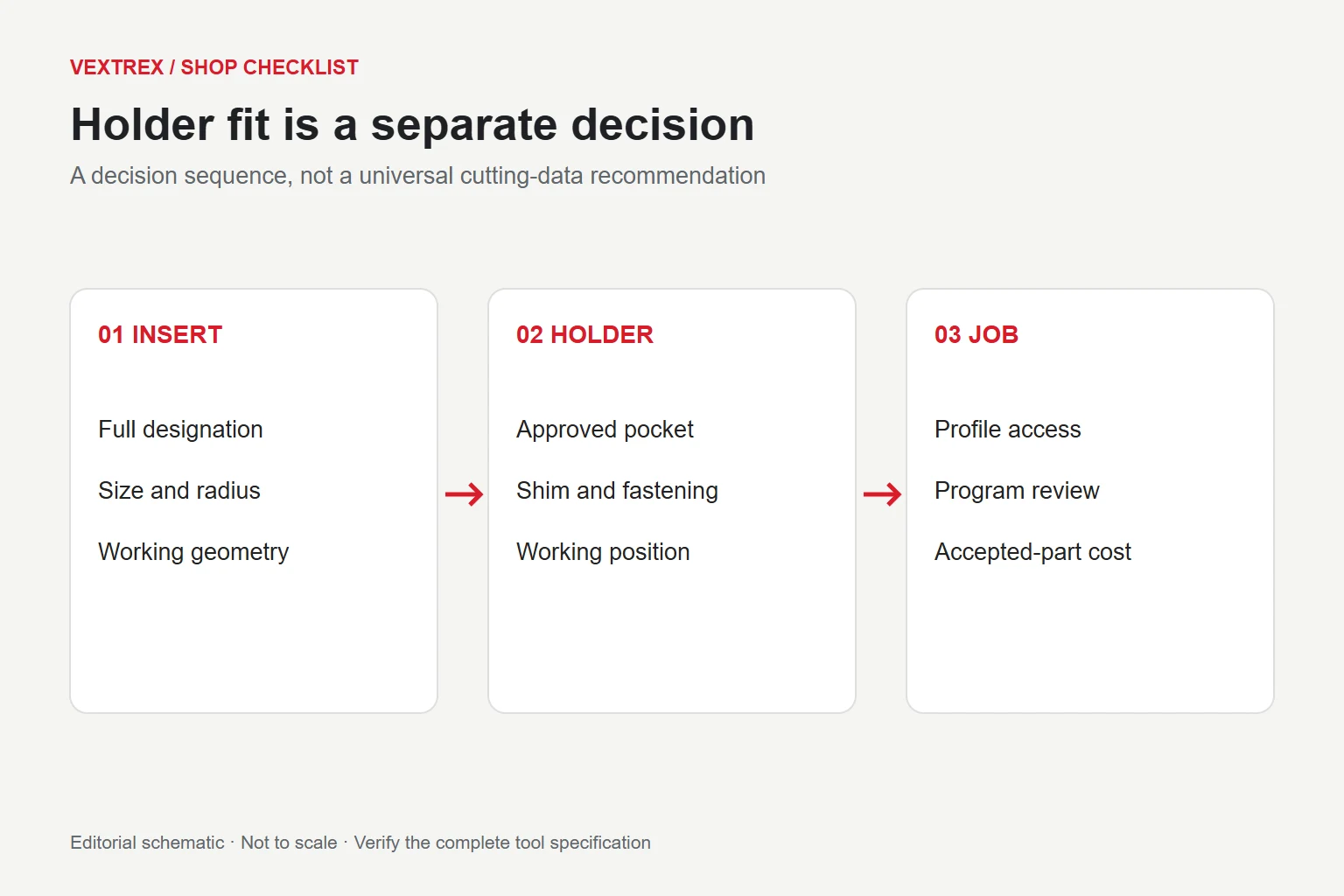
Read the full size and radius designation before comparing dimensions. Different numerical codes follow their own family references; matching one nominal dimension does not prove compatibility. Use the actual drawing rather than an informal visual comparison.
2. Choose by the Component and Existing Tooling
Keep CNMG as the working choice when the existing assembly reliably produces the required component and a change has no clear production objective. Avoid buying another holder simply because a six-corner insert appears cheaper on paper.
Consider a WNMG trial when a compatible assembly can perform the required cuts and its available geometry addresses the job. Check external turning, facing, shoulders, access and clearance in the complete setup. Do not assume either family can reach every feature.
For heavy stock removal, compare the actual cutting length, insert thickness, pocket support and manufacturer application range. For a slender part or vibration-prone setup, compare the required force and stability conditions. Shape alone cannot establish that WNMG gives lower forces or that CNMG always permits deeper cuts.
Sandvik’s turning insert selection guide treats shape, size, geometry, grade and tool angle as related decisions rather than a single ranking of insert families.
Inspect the proposed tool path and update offsets and compensation where necessary. A change that fits the turret still requires review of the insert’s actual working position. Prove the setup using the shop’s approved commissioning procedure before production.
Используйте CNMG product references и WNMG product references to prepare two comparable inquiries. Include the holder code with each one; avoid asking for an “equivalent insert” without identifying the intended pocket.
3. Compare Cost per Acceptable Part
Count the corners your shop can actually use. If an operator discards an insert after one corner because another face is damaged or the setup cannot use it, theoretical edge count overstates the saving.
For a useful comparison, record:
- Insert price and confirmed usable corners.
- Acceptable parts produced by each indexed corner.
- Indexing time, offset checks and extra setup time.
- Scrap, rework and unscheduled tool changes.
- Any new holder, shim, screw or spare-part requirement.
Calculate insert cost per acceptable part by dividing the insert cost by the acceptable parts obtained from that insert. Evaluate holder and setup costs separately over a realistic production quantity. Do not compare one insert’s best corner with another’s average production result.
Keep material, inspection criteria and setup records comparable. If one configuration needs different cutting conditions, document them. You are comparing two usable process options; you are not proving that the outline alone caused a difference.
Distributors should keep the full trial designation on the quotation and reorder record. A customer accepting one grade and chipbreaker has not approved every insert in that shape. Confirm substitutions before delivery.
Where stainless steel chipping is the real reason for changing tools, use our insert chipping diagnostic guide before switching families. For cast components, consult the cast iron grade selection guide: shape selection does not replace grade selection.
4. Frequently Asked Questions
Can WNMG replace CNMG in the same holder?
Not by assumption. The pocket outline and supporting surfaces differ. Use only the complete configuration explicitly approved by the holder manufacturer.
Does WNMG always cost less per part?
No. Six available corners can be useful, but usable tool life, rejects, indexing time and holder costs determine the production result. Measure these on the intended job.
Which family is better for stainless steel?
Neither name answers that question. Select an appropriate grade and geometry for the alloy, cut, setup and finish requirement, then confirm them by trial.
Summary
Keep a successful assembly unless a change has a measurable purpose. Compare complete CNMG and WNMG configurations using approved fit, component access and acceptable-part records.
Request a matched quotation or sample. Send the full insert code, holder designation, workpiece material, operation, quantity and destination. Review our CNMG поворотные вставки и WNMG поворотные вставки. Standard carbide insert samples are free in complete boxes of 10; the buyer pays freight, confirmed after inquiry. Identify the exact sample configuration before dispatch.
Technical sources
Нужна помощь в подтверждении точной спецификации инструмента?
Отправьте код модели, четкие фотографии инструмента, материал заготовки и задачу обработки. Мы рассмотрим совместимость и детали приложения, прежде чем подтвердить доступные варианты, цену и время выполнения.