
Choose milling direction from the cutter’s motion at the engaged side of the workpiece, not from spindle rotation alone. Climb and conventional milling produce different chip-thickness histories and loading. Before changing between them, check the machine’s feed system, workholding and the toolmaker’s guidance for the operation.
Mark the actual side of engagement
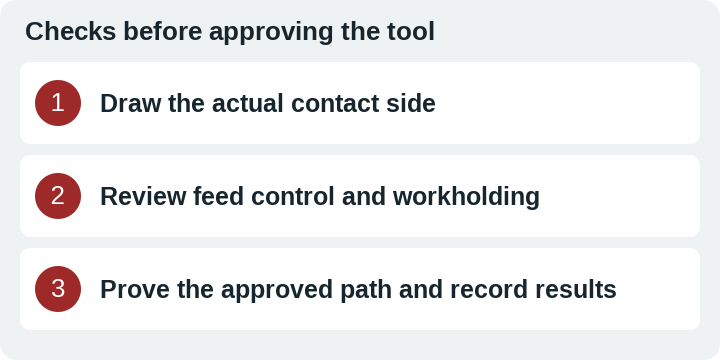
On a simple plan view, draw the spindle rotation, feed direction and the side of the cutter touching material. Moving the cutter to the other side of the same feature can change the engagement relationship even when spindle rotation stays the same. Avoid giving the programmer an instruction such as “always cut clockwise” without showing whether the path is inside or outside the part.
Understand the basic difference
Sandvik Coromant describes down or climb milling as a thick-to-thin chip process and generally prefers it where the machine and setup permit. In up or conventional milling, the chip grows from zero thickness, with rubbing at entry. Those principles help explain a process choice; they do not make one direction automatically suitable for every machine or workpiece.
Review backlash and holding
In climb milling, pulling into the cut can become a problem when the machine cannot properly control table-feed play. Sandvik specifically identifies backlash control as a consideration and discusses up milling in such cases. Have the responsible operator assess machine condition and holding security. Do not treat a different insert grade as a repair for a feed system that cannot safely control the selected cut.
| Item | What to verify |
|---|---|
| Spindle rotation | Insufficient alone; identify the engaged side of the cutter |
| Climb/down milling | Chip generally progresses from thick to thin |
| Conventional/up milling | Chip generally progresses from zero to greater thickness |
| Machine condition | Review feed control, backlash and secure workholding |
Compare an approved path, not a slogan
For a trial, retain the drawing, material, cutter and insert codes, engagement and programmed feed. Mark the actual path revision and record edge condition and accepted surface quality. If the fixture, cutting data and direction all change, report the combined process rather than claiming that direction alone improved tool life. Save the proven setup with the tooling specification for repeat work.
Qué enviar con su consulta
For a Vextrex tooling review, include a sketch of the cutter path, the material and existing cutter and insert codes. This lets the discussion address the actual engagement rather than rotation wording alone. Contact Vextrex.
Related reading: milling insert and cutter identification · long-reach milling stability.
Technical references
¿Necesita ayuda para confirmar la especificación exacta de la herramienta?
Enviar el código modelo, fotos de herramientas claras, material de pieza y tarea de mecanizado. Revisaremos la compatibilidad y los detalles de la aplicación antes de confirmar las opciones disponibles, precio y tiempo de entrega.