

For a single-insert turning operation, start with the insert purchase cost divided by the accepted parts produced across its usable edges. A lower price per insert may still give a higher consumable cost per accepted part. Keep this calculation separate from total machining cost, which also depends on cycle time, tool changes, rejects and other shop costs. The worked figures below are hypothetical arithmetic examples, not Vextrex quotations or trial results.
Define the unit before comparing prices
Check whether the quotation is per insert or per box and how many inserts the box contains. Use the same currency, tax treatment and purchasing basis for both candidates. Record freight or other acquisition costs separately, or allocate them consistently if comparing landed consumable cost. For this article, “usable edges” means the edges that can actually perform the specified operation with the approved setup. Count neither inaccessible corners nor corners lost when an insert breaks as productive edges.
Calculate the consumable portion
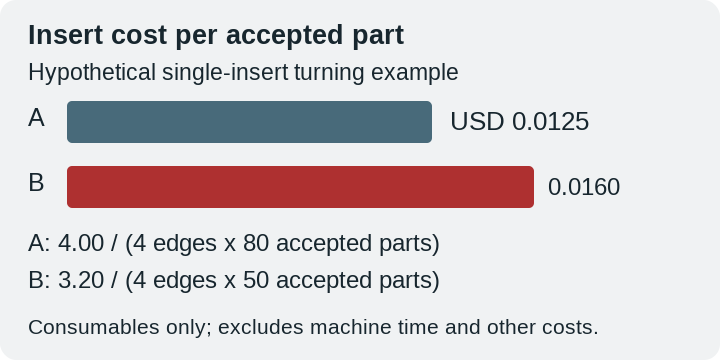
In a simple planning model, insert cost per accepted part = price per insert ÷ (usable edges per insert × accepted parts per edge). Suppose candidate A costs USD 4.00, has four usable edges and produces 80 accepted parts per edge: 4.00 ÷ (4 × 80) = USD 0.0125 per accepted part. Candidate B costs USD 3.20, has four usable edges and produces 50 accepted parts per edge: 3.20 ÷ (4 × 50) = USD 0.0160. Under these assumptions, B is cheaper to buy but more expensive in insert consumption. This comparison says nothing yet about total production cost.
Use actual totals when edge life varies
The planning formula assumes the stated number of usable edges and a representative output per edge. During a trial, keep an edge-by-edge record and use total consumable cost attributable to the run divided by total accepted parts. Record how remaining insert life is allocated when a trial ends partway through an edge; otherwise the comparison can penalize the candidate stopped earlier. Separate the first setup pieces from normal production and document the agreed quality limit used to change an edge.
| Item or observation | Check or calculation |
|---|---|
| Candidate A: USD 4.00 per insert | 4 usable edges × 80 accepted parts = 320; USD 0.0125 per part |
| Candidate B: USD 3.20 per insert | 4 usable edges × 50 accepted parts = 200; USD 0.0160 per part |
| Cycle time and change time | Not included in the two consumable figures; record separately |
| Quality basis | Use the same agreed acceptance criteria for both candidates |
| Result status | Hypothetical example only; substitute measured shop data |
Account for time and rejects without double counting
For a broader comparison, define a common cost boundary. Include consistently allocated insert consumption, chargeable machine and operator time, and any agreed scrap or rework costs, then divide by accepted output. If the shop’s hourly machine rate already includes an operator or overhead, do not add those costs again. Rejects reduce the accepted-output denominator; add their material or rework cost only where that cost is not already included. Sandvik’s cost-control discussion treats tooling in the wider production process, while its turning guidance shows why parameters and maintenance must accompany a tool-life comparison.
Use the result to select the next trial
Compare candidates on the same part, material and quality requirement. Record cycle time, insert changes, stoppages and the reason each edge was removed. If cutting conditions differ, report the complete process for each candidate rather than calling it a direct grade comparison. Repeat promising results across more than one edge before making a supply decision. A low consumable cost does not qualify a tool that misses tolerance, damages the part or fails unpredictably.
Qué enviar con su consulta
Tell Vextrex the operation, material, current insert configuration and required quantity when asking for a quotation. If you have trial data, include accepted output per edge and the quality limit so the price comparison has a clear basis. Contact Vextrex.
Related reading: sample trial record · grade and coating selection.
Technical references
¿Necesita ayuda para confirmar la especificación exacta de la herramienta?
Enviar el código modelo, fotos de herramientas claras, material de pieza y tarea de mecanizado. Revisaremos la compatibilidad y los detalles de la aplicación antes de confirmar las opciones disponibles, precio y tiempo de entrega.