
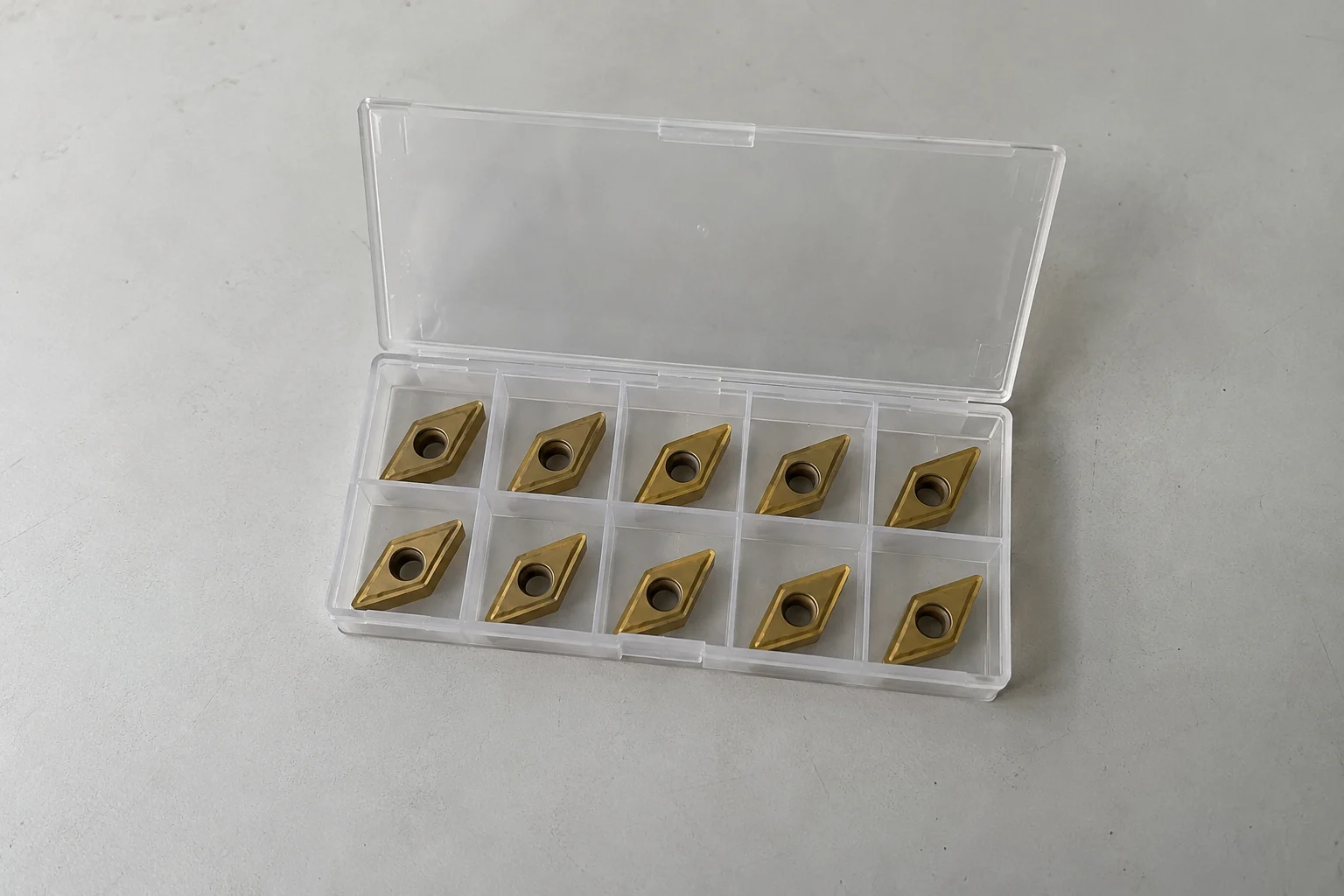
A useful carbide insert trial answers a purchasing question: can the proposed, fully specified insert meet this job’s requirements in a repeatable setup? Record the current tool, verify holder fit, agree acceptance criteria and compare the results before approving a production order. A sample photograph, a matching four-letter family code or one successful component cannot replace that process.
1. Identify exactly what you are replacing
Copy the complete marking from the existing box and insert. Include the size code, chipbreaker suffix, grade and corner radius where specified. Record the holder or cutter-body designation, clamp and screw references. If the grade is unreadable, say so and send clear photographs; do not fill the gap with a guess.
Usar el CNMG turning insert model references or the relevant family page to start the comparison. The table identifies dimensions and catalog options. It does not prove that two suppliers’ grades or chipbreakers are equivalent.
2. Separate mechanical fit from application suitability
Before machining, confirm the proposed insert fits the intended seat and fastening system. Check the seating face, thickness, fixing arrangement, corner radius and working clearance against the holder documentation. A loose insert with a similar outline is not enough evidence of compatibility.
For milling, review the actual cutter pocket and full designation using the APMT milling insert references. For a drill body with different pocket positions, identify whether the sample is intended for the centre or periphery. Resolve these questions before cutting a part.
3. Document the job and agree acceptance criteria
Record the workpiece alloy, hardness condition, operation, continuous or interrupted cut, coolant, holder setup, cutting speed, feed and depth of cut. State the required surface finish and dimensional tolerance from the component drawing. Do not assume a catalog insert tolerance is the finished-part tolerance.
Agree how the trial will be judged before running it. Criteria may include dimensional consistency, surface finish, chip control, edge damage and usable cutting time. Record the measurement method, inspection points and reason for stopping a run. Use grade- and geometry-specific manufacturer guidance for the proposed tool; do not invent a universal starting speed.
4. Keep the comparison interpretable
Start with a documented baseline from the current tool. Keep the workpiece batch, holder, inspection method and relevant setup conditions comparable. If the alternative tool requires a different cutting condition, record that change explicitly. A trial that changes the grade, chipbreaker, coolant and feed simultaneously cannot isolate which change caused the result.
Check tool seating and machine conditions when results vary. Do not attribute every damaged edge to carbide quality. The grade and coating selection guide explains the variables to review before requesting another configuration.
5. Use a simple trial record
| Record | What to enter |
|---|---|
| Identidad de la herramienta | Full insert code, grade, chipbreaker, corner radius and batch reference |
| Mechanical setup | Holder or body code, seat, fastening parts, pocket position and projection |
| Pie de trabajo | Alloy, hardness condition, drawing reference and batch |
| Condiciones de corte | Operation, speed, feed, depth of cut, coolant and any change from the baseline |
| Acceptance | Drawing tolerances, finish requirement, measurement method and stop criteria |
| Observed results | Measured dimensions, finish, chip behavior, edge condition and usable cutting time |
| Decision | Repeat trial, review configuration or approve the specific quoted configuration |
6. Confirm sample quantity and freight before dispatch
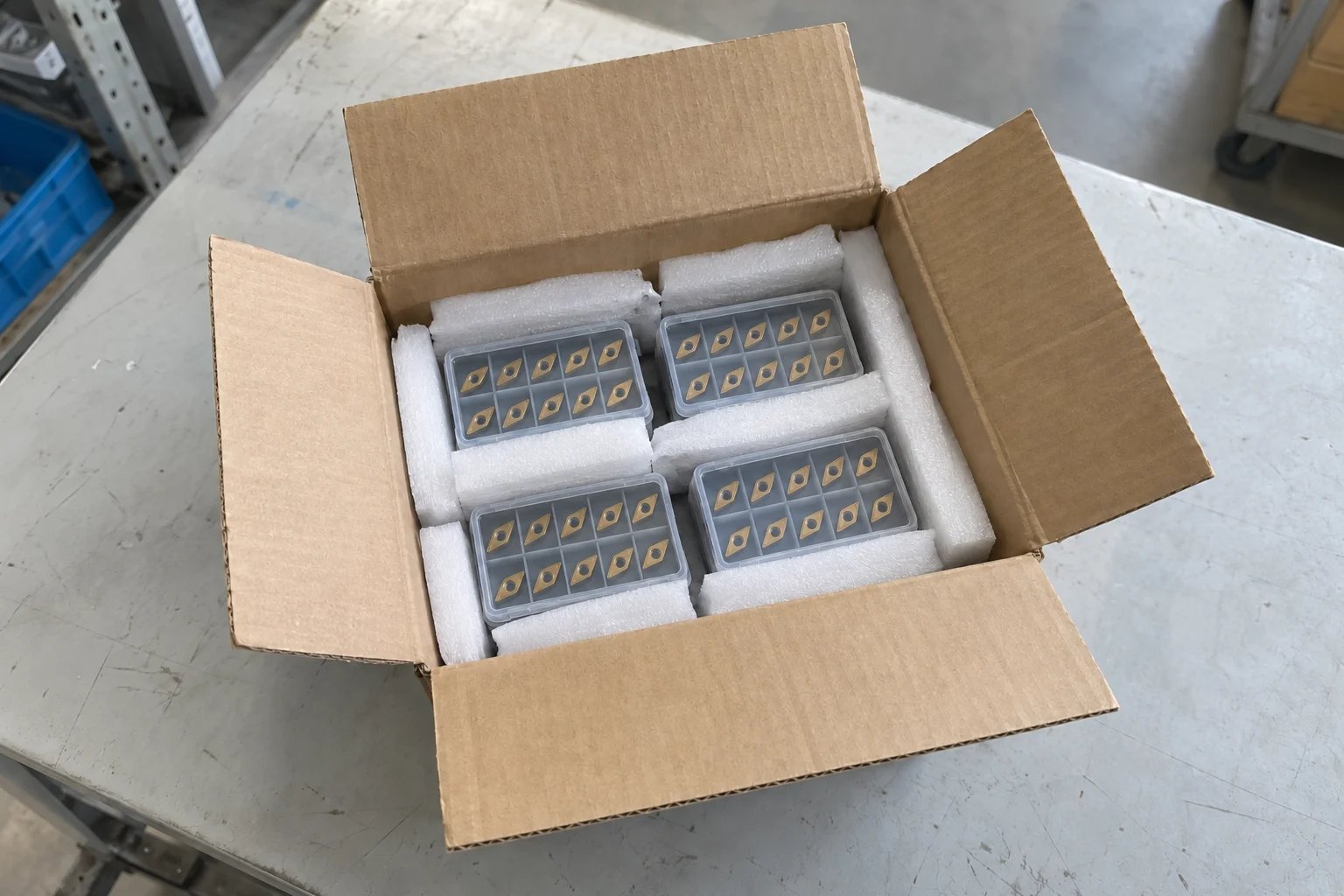
Vextrex’s standard carbide insert samples are free of product charge and supplied as one complete box of 10 inserts. The buyer pays freight; the amount is confirmed after inquiry using the destination. Confirm the exact available sample designation and dispatch arrangement before shipment. The 10-piece sample policy does not establish the minimum quantity for a production order or custom packaging.
Tell us whether the trial is for a machining shop or a distributor’s customer. Distributors should also agree how the customer will identify the tested configuration and record the results. Keep a traceable record instead of comparing unlabeled loose inserts.
7. Carry the accepted specification into the quotation
A successful trial approves the tested configuration and conditions, not every insert sharing the family name. Retain the complete code, grade, chipbreaker, coating, accepted batch or trial reference, inspection requirements and packaging specification. Confirm any proposed substitution before ordering.
Vextrex can normally provide dispatch dimensional inspection records and actual appearance inspection photos. Material composition reports can be discussed for batch orders; confirm the required documents during the inquiry. Standard packing is the original plastic box. Private labels or customer-specific labels can be discussed, with the custom-packing minimum quantity confirmed by quotation.
Request a sample configuration review with the existing insert code, holder, alloy, trial quantity and destination. If a marking is missing, include the box label, insert photographs and relevant drawing.
Preguntas frecuentes
Does one good component prove that the replacement is qualified?
No. Repeatability, edge condition, measurement consistency and the agreed acceptance criteria still need review. Set the trial scope according to the job’s purchasing risk.
Should I select the replacement only by coating color?
No. Color does not identify the complete substrate, coating system or edge geometry. Ask for the specified configuration and supporting reference.
Can I compare two inserts using different cutting conditions?
You can evaluate configurations under their appropriate conditions, but record the changes and do not attribute the result solely to the insert material.
Technical Sources and Scope
The checklist is purchasing guidance, not a cutting-data table or a report of a Vextrex performance trial. Manufacturer guidance supports reviewing tooling, workpiece and process conditions; use the exact tool supplier’s data for speeds, feeds and fit.
¿Necesita ayuda para confirmar la especificación exacta de la herramienta?
Enviar el código modelo, fotos de herramientas claras, material de pieza y tarea de mecanizado. Revisaremos la compatibilidad y los detalles de la aplicación antes de confirmar las opciones disponibles, precio y tiempo de entrega.