
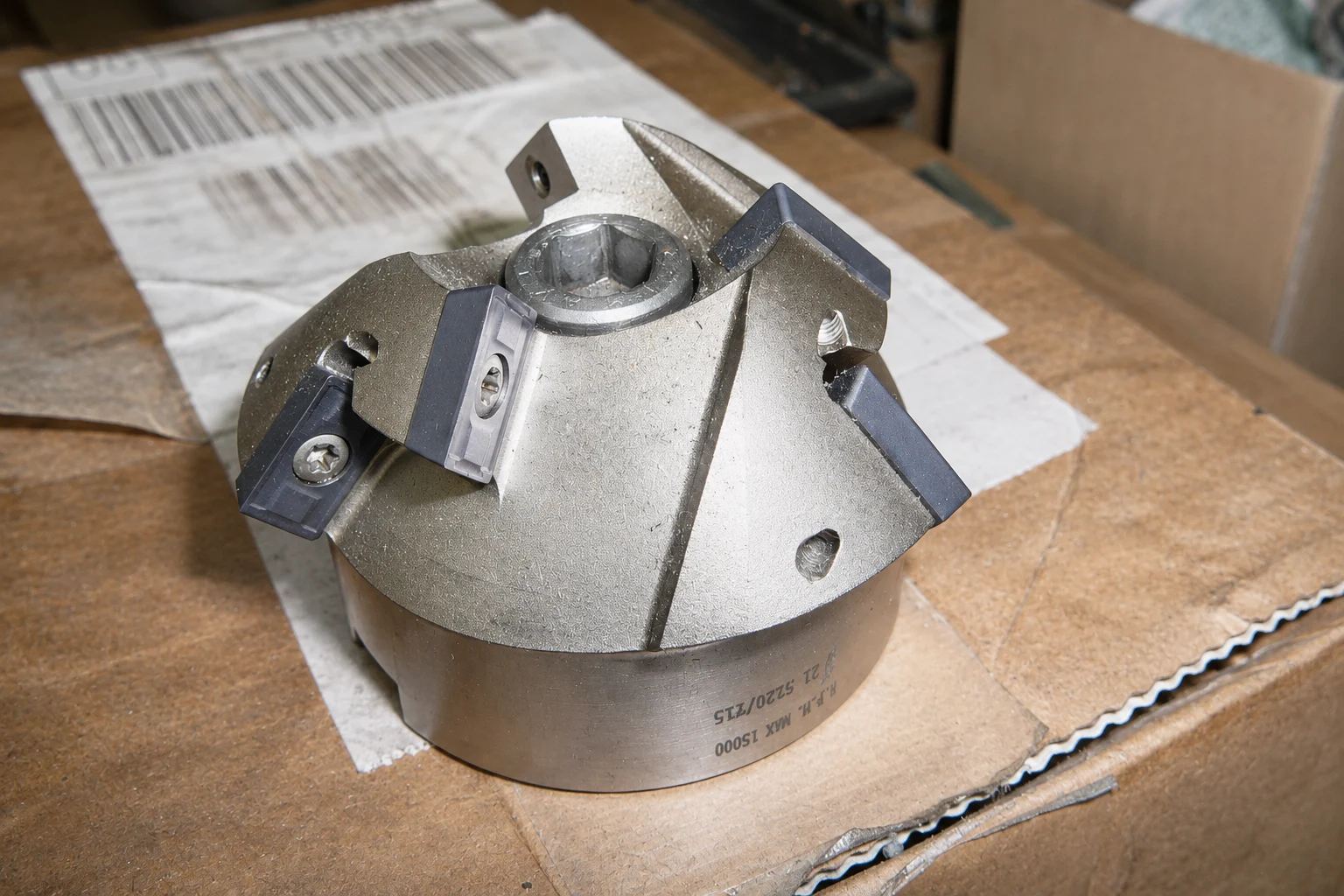

Two face mills with the same diameter can have different insert counts and tooth spacing. More inserts can support higher table feed in a suitable process, but they also change chip space and the load presented to the machine. Choose pitch with the cut, machine and material in mind rather than treating the fullest cutter body as the most productive option.
Separate tooth count from the number in the cut
The total number of cutting positions is a tool specification. How many edges engage at a given instant also depends on the cutter path and width of cut. Record both the cutter body and actual engagement when comparing options. A count taken from a photograph does not tell the supplier how much of the cutter will be loaded on your part.
Understand the pitch trade-off
Sandvik’s pitch-selection guidance explains that closer spacing leaves less room for chip evacuation and that power can limit how many edges are productively engaged. Its coarse-pitch recommendations address conditions such as limited power or instability, while closer pitches have other application areas. These are selection principles, not interchangeable labels across every maker. Confirm the exact body version and its intended operating range.
Do not confuse differential pitch with simply fewer teeth
Differential pitch describes unequal tooth spacing. It is a distinct design feature used to address vibration behaviour, not another name for every coarse-pitch cutter. Ask whether a proposed body is evenly or differentially pitched and compare the manufacturer’s application data. Keep the insert geometry and entering angle visible in the comparison instead of crediting tooth spacing for every difference.
| Item | What to verify |
|---|---|
| Tooth count | Total cutting positions in the specified body |
| Hành động | How many edges contact the workpiece during the path |
| Close pitch | Consider chip space and available power |
| Differential pitch | Unequal spacing; confirm the exact body design |
Recalculate the feed for the chosen body
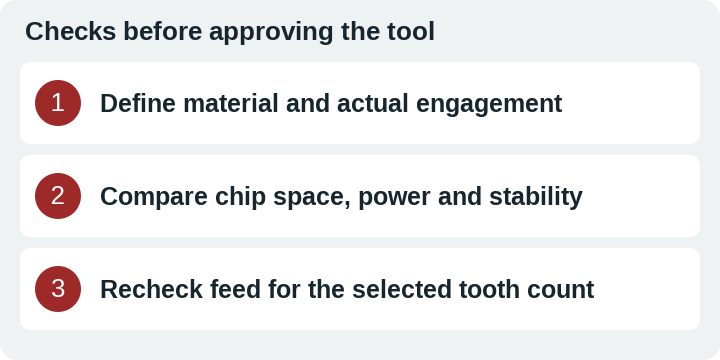
For a conventional milling-feed calculation, table feed depends on spindle speed, feed per tooth and the applicable tooth count. Confirm the maker’s definitions and the approved cutting strategy before programming. Retaining the same table feed after changing tooth count changes the nominal feed per tooth. Record the calculation inputs, then trial the assembly under the machine’s power, holding and toolmaker limits.
Những gì cần gửi cùng với yêu cầu của bạn
Tell Vextrex the face width, material, cutter diameter, machine interface and current body code. Include available spindle power from the machine documentation when comparing a different pitch. Contact Vextrex.
Related reading: insert and body matching · milling stability checks.
Technical references
Cần giúp xác nhận chính xác công cụ cụ không?
Gửi mã số mô hình, ảnh công cụ rõ ràng, vật liệu làm việc và công việc gia công. Chúng tôi sẽ xem lại các chi tiết tương thích và ứng dụng trước khi xác nhận các lựa chọn, giá cả và thời gian dẫn đầu.