
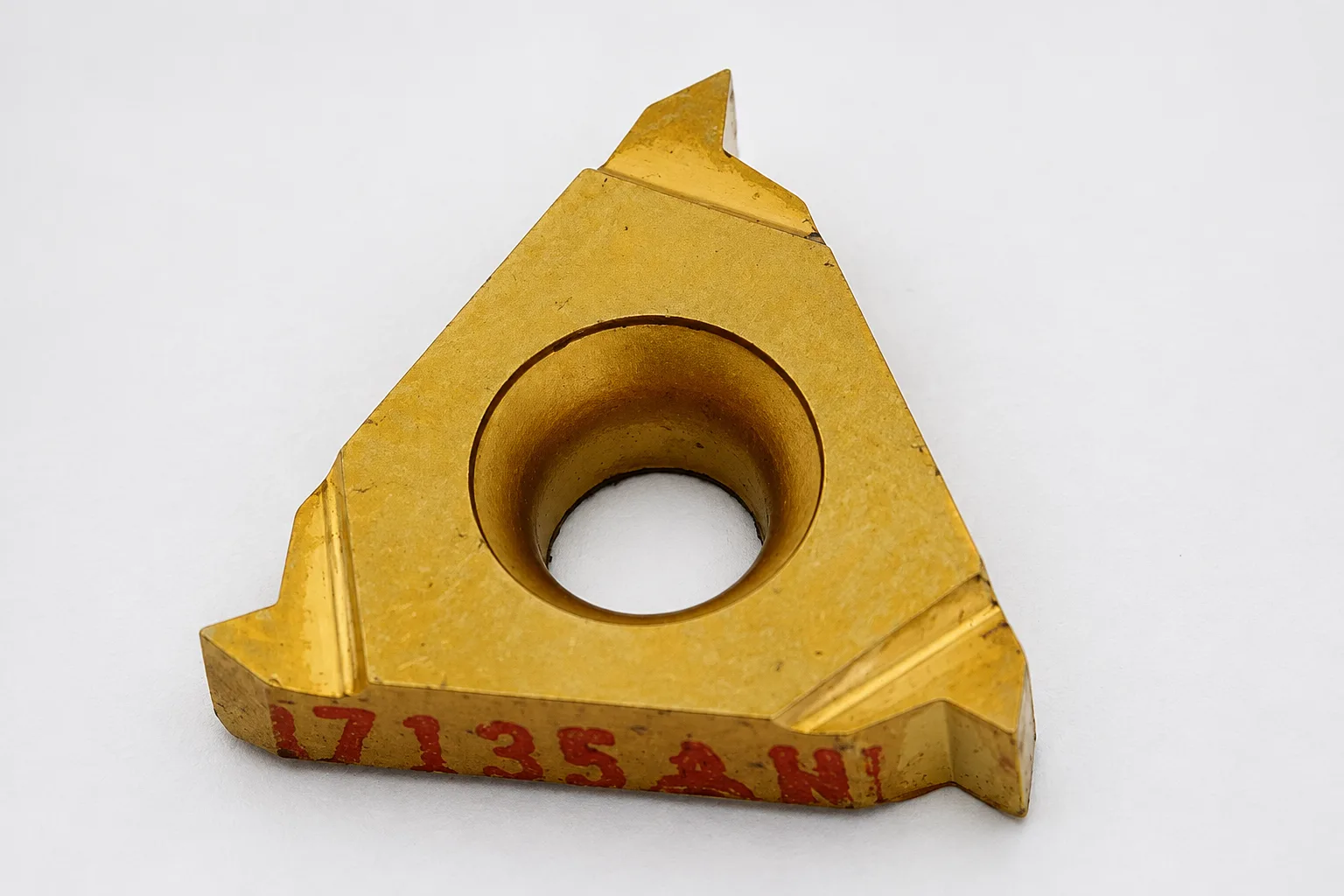

To select a thread turning shim, start with the lead at the thread pitch diameter and the cutting direction. A shim changes how the insert tilts in the holder so that both flanks have suitable clearance. Buying by insert size or thread pitch alone can leave you with the right insert and the wrong setup.
Use lead rather than pitch for multi-start threads
Pitch is the distance between adjacent thread forms; lead is the axial distance advanced in one revolution. Lead equals pitch for a single-start thread. For example, a two-start thread with a 2 mm pitch has a 4 mm lead. For a given pitch diameter, the larger lead gives a larger helix angle. Use the pitch diameter and lead in the holder maker’s chart, especially when the thread is small or has multiple starts.
Look up the shim in the correct system
Check the exact holder code, whether the cut is internal or external, the thread hand and the machining direction. The sign of the shim inclination depends on the setup and the manufacturer’s convention. Do not transfer a shim code or assume a nominal angle from another tooling family. Keep the chart decision separate from selecting the insert’s actual thread form.
| What you observe | What to check |
|---|---|
| Pitch and number of starts | Determine lead per revolution |
| Pitch diameter and lead | Find the helix angle range in the maker’s chart |
| Holder and cutting direction | Confirm supported shim code and sign |
Review the first thread before you reorder
Unequal flank wear or a rubbed flank is reason to check tilt, alignment and infeed as well as tool condition. Record the current shim marking, confirm both flank clearances according to the tooling guide, and inspect the first thread against the drawing and specified gauge. A worn edge on one side alone is not proof that the shim angle was wrong.
Что отправить с запросом
Include the drawing callout, number of starts, actual holder code and current shim marking when asking for a quote. Send your tooling details.
Related: 16ER Внешние резьбовые вставки · 16IR вставки для внутренней резьбы · full versus partial profile guide.
Technical references
Нужна помощь в подтверждении точной спецификации инструмента?
Отправьте код модели, четкие фотографии инструмента, материал заготовки и задачу обработки. Мы рассмотрим совместимость и детали приложения, прежде чем подтвердить доступные варианты, цену и время выполнения.