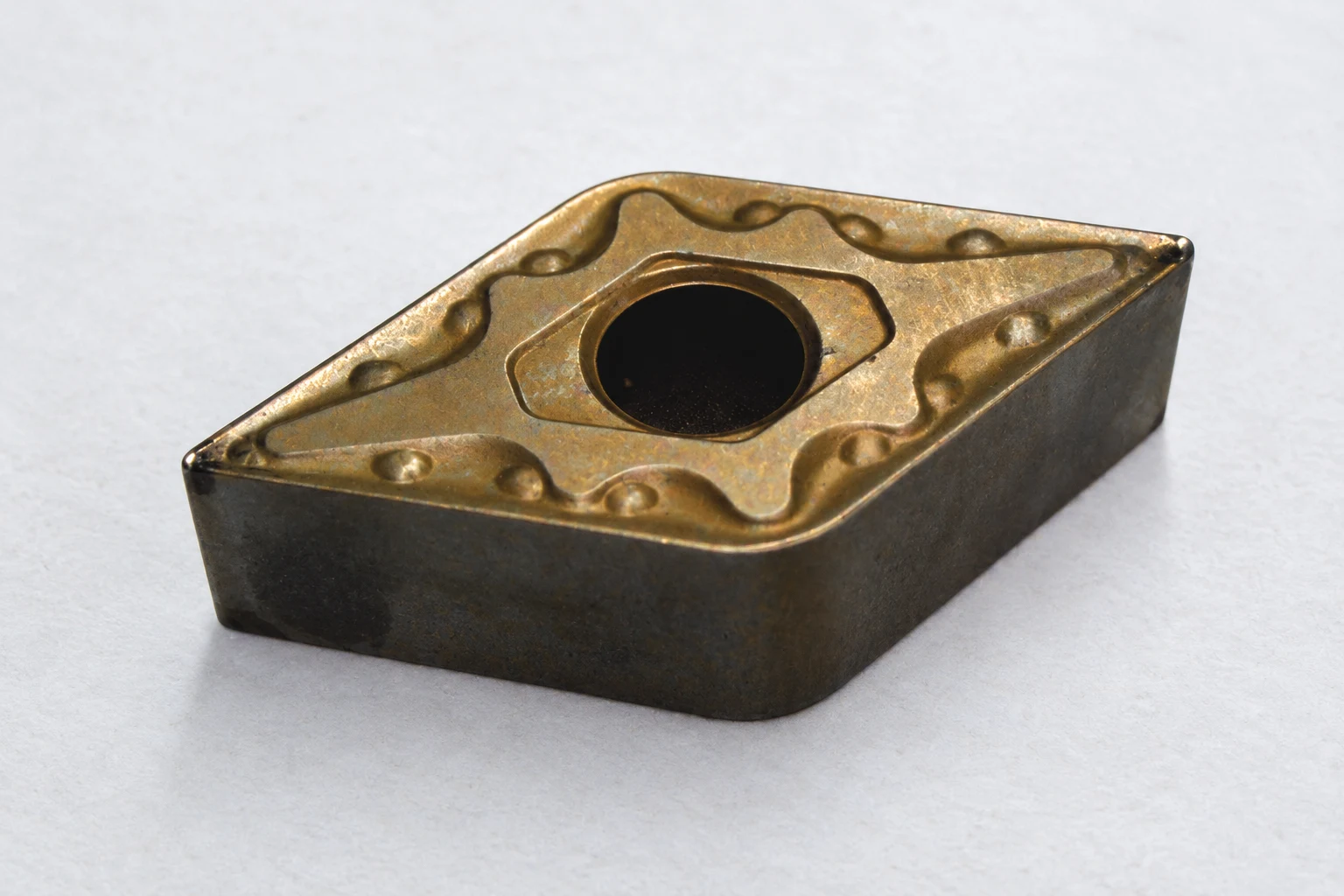

Быстрый ответ
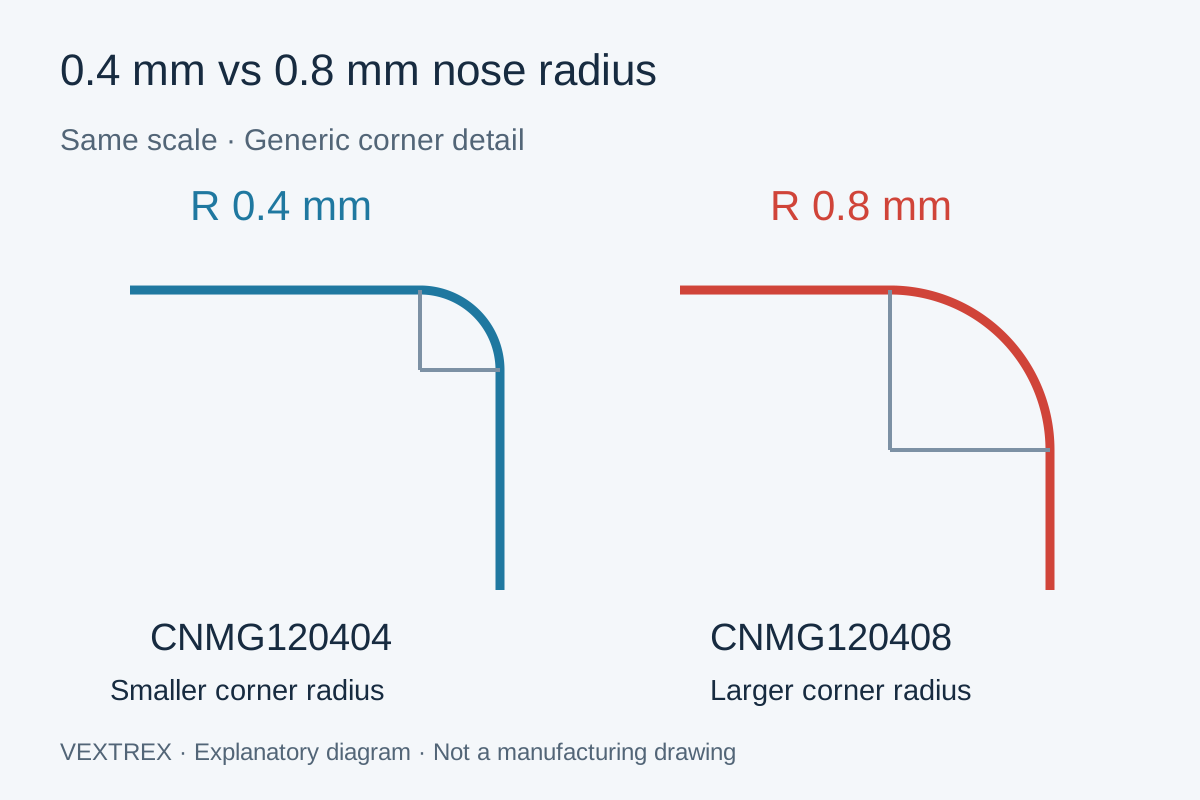
CNMG120404 has a 0.4 mm nominal nose radius; CNMG120408 has a 0.8 mm nominal nose radius. Neither is automatically the better finishing insert. A smaller radius can help a vibration-prone setup, while a larger radius offers a stronger corner and can support higher feeds when the setup is stable. Check the actual chipbreaker, grade and holder before substituting one for the other.
This guide addresses a repeat-order decision: your current CNMG120408 is giving an unsatisfactory finish, and you are considering CNMG120404. It is a selection checklist, not a tested cutting recipe. For the complete designation system, see our insert-code guide.
What changes between 120404 and 120408?
Kennametal lists representative CNMG120404MP and CNMG120408MP products with corner radii of 0.4 and 0.8 mm respectively. This verifies the radius distinction; it does not establish that two different suppliers’ products have equivalent coatings or chipbreakers.
| Проверить | CNMG120404 | CNMG120408 |
|---|---|---|
| Nominal nose radius | 0.4 mm | 0.8 mm |
| Reason to consider it | Small finishing allowance or a tendency to vibrate | Corner strength and higher-feed work in a stable setup |
| What the number does not specify | Supplier grade, coating, chipbreaker, edge preparation or recommended cutting data | |
| Before a swap | Confirm exact holder approval and update the programmed nose-radius value and tool offsets | |
Start with the finish problem, not the insert colour
Sandvik Coromant’s selection guidance links radius choice to feed, depth of cut, chip control and rigidity. It recommends considering a smaller radius when vibration occurs, and describes the larger radius as providing greater edge security while increasing radial forces. Its general rule of thumb is to keep nose radius at or below depth of cut; that is guidance to review for the application, not a universal finishing-pass setting.
Write down what “poor finish” means before changing the order. Is the problem periodic waviness, visible feed marks, material adhering to the edge, or damage appearing after several parts? Include a close-up photograph and the surface-finish requirement from the drawing. These observations are more useful to a supplier than “send a better finishing grade.”
A controlled selection check
- Record the current tool. Photograph the box label, unused insert and complete holder marking. Keep the grade and chipbreaker suffixes.
- Record the operation. State material specification, hardness if known, outside or inside turning, interrupted features and the remaining machining allowance.
- Describe the setup. Include workpiece diameter, unsupported length, holder overhang and how the part is supported.
- Ask for a matched recommendation. Request the proposed radius, chipbreaker and grade together with that product’s documented operating window.
- Plan the comparison. Have the machine operator record the program, offsets, tool condition, finish and dimensional result for each trial. Do not assume a radius change alone proves the cause.
Can both inserts use the same holder?
The common family and size portion makes this a plausible replacement question, but it is not blanket approval. Ask the holder manufacturer or supplier to confirm the complete insert designation, pocket, shim and clamping arrangement. Do not force an insert into a damaged or unsuitable seat.
A change of nose radius also changes a programming input. The operator needs to review tool-nose-radius compensation, approach and exit moves, and any profile or corner requirement before running the part. “It fits the pocket” and “the program is correct for it” are separate checks.
What to send with your inquiry
Use this short request: “Current insert: [complete code and grade]. Holder: [complete code]. Material: [specification]. Operation: [finish/roughing and continuous/interrupted]. Current feed, speed and depth: [values with units]. Problem and target: [photos and drawing requirement]. Please review whether 0.4 or 0.8 mm radius is suitable and identify the exact proposed product.” Add quantity and destination for a usable quotation.
Обзор CNMG поворотные вставки и MCLNR turning holders. Availability, compatibility, price and lead time require confirmation for the specific request.
Common questions
Does 120404 always give a smoother finish?
No. Radius is one input. Feed, chipbreaker, edge condition, material and setup stability also matter; verify the result on the actual part.
Can I leave the old nose-radius setting in the program?
Have the operator review it. The nominal radius changes from 0.8 to 0.4 mm, so the tool record and compensation must match the tool being used.
Technical references and scope
- Kennametal CNMG120404MP: 0.4 mm corner radius.
- Kennametal CNMG120408MP: 0.8 mm corner radius.
- Sandvik Coromant: turning-insert selection and nose radius.
References checked October 5, 2026. Product examples establish the stated dimensions only. The inquiry and comparison checklists are Vextrex editorial guidance; no machining trial or guaranteed surface finish is claimed.
Нужна помощь в подтверждении точной спецификации инструмента?
Отправьте код модели, четкие фотографии инструмента, материал заготовки и задачу обработки. Мы рассмотрим совместимость и детали приложения, прежде чем подтвердить доступные варианты, цену и время выполнения.