
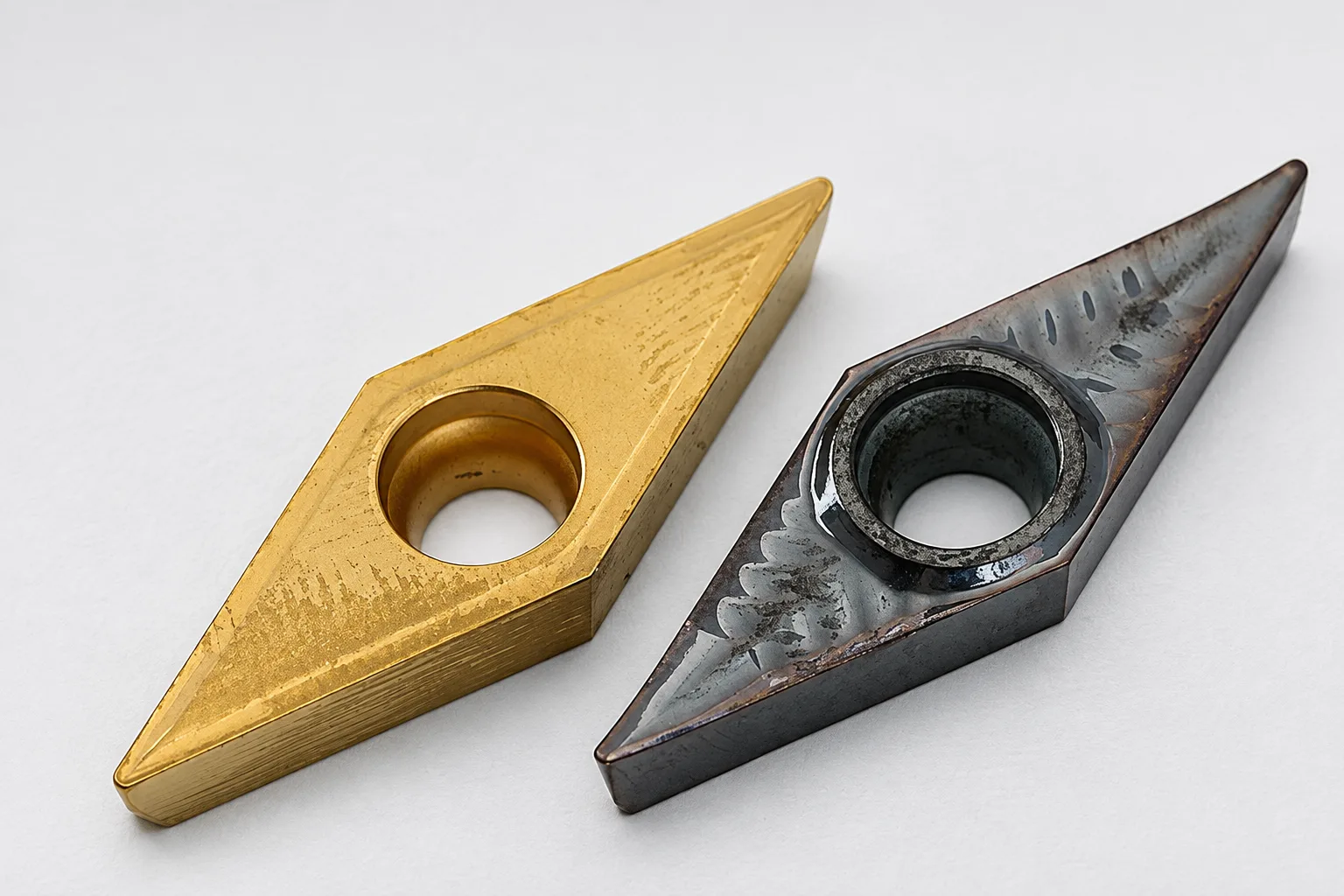

Try a wiper turning insert when feed marks limit the finish on a stable straight-turning or facing pass. A wiper uses a modified finishing edge to smooth the feed pattern. It will not solve chatter, workpiece deflection or a loose insert seat, so identify the dominant problem before buying.
Check that the problem is consistent with feed marks
A regular spiral on a turned diameter can be consistent with feed marks. Compare it with a chatter pattern or material built up on the edge. Check the workpiece support and tool overhang. A thin part, a long internal bar or a flexible setup may respond better to a setup correction than to an edge designed for more contact.
Use the orientation specified for that geometry
Check the insert maker’s application diagram against the holder approach angle and feed direction. A wiper designed for a straight pass may not give the same result in profiling, and the insert family code can be the same as a conventional insert even when its geometry suffix differs. Check the complete code and approved holder combination before treating it as interchangeable.
| What you observe | What to check |
|---|---|
| Stable straight turning, visible feed pattern | Check approved wiper geometry and trial it |
| Chatter or taper on a flexible part | Address support and tool overhang first |
| Mixed profiles and shoulders | Check contact and orientation for each pass |
Make a finish-first sample comparison
Run a baseline with a fresh conventional edge, and measure roughness on the same location and direction on the next sample using the specified measurement method. Run the wiper candidate within the maker’s valid cutting range. Compare finish and size before increasing feed in a separate step, and watch for higher load, chatter or new dimensional variation. Record the actual condition rather than assuming a catalog productivity figure transfers to the job.
Qué enviar con su consulta
Include the current insert and holder codes, material, finish requirement and cut direction. A family page is a starting point, not confirmation that a specific wiper suffix is stocked. Send your tooling details.
Related: SNMG turning insert family · CNMG turning insert family · controlled insert comparison guide.
Technical references
¿Necesita ayuda para confirmar la especificación exacta de la herramienta?
Enviar el código modelo, fotos de herramientas claras, material de pieza y tarea de mecanizado. Revisaremos la compatibilidad y los detalles de la aplicación antes de confirmar las opciones disponibles, precio y tiempo de entrega.